



Reimagining Feminist Pedagogy: Embodiment, Creativity, and Transformative Learning: A Conversation with Kimberly George, Part I.

What happens when we recognize that learning is not solely an intellectual exercise but also an embodied, emotional, and creative process? How might feminist pedagogy make room for different ways of sensing, writing, and making meaning? In the first of a two-part conversation, Jessica Knippel speaks with Kimberly George about sensory experience, consent-based pedagogy, academic writing, and the place of play in transformative education. Drawing on religious studies, ethnic studies, and gender studies, they consider what it means to honor students’ distinct ways of knowing while questioning the academic habits that constrain them.
Embodied ways of learning
Interviewer (Jessica Knippel): How, beyond just the readings, do you cultivate a pedagogy that supports and honors your students and helps them do this work? Because I have seen you in practice at our guild meetings, and through just your networks and the way you approach research, the way you approach getting research texts, the way you were so conscientious during COVID, making sure you were giving access to people who were losing access to things. How does that inform your presence in the classroom as well? Does that make sense to that question?
Kimberly George: It does. I mean, first of all, I learned a lot from you, so thank you; you model all these things, and I get to learn from you. There are lots of ways to answer this question, of course, but one that I am excited to be able to do more with—that I have not fully leaned into in the past because I was on my own journey to understand myself—is that I am thinking a lot about sensory experience as part of learning. Especially with writing practices, we need to connect our sensory experience to language on a page. That is a huge translation of non-verbal perception. And we just assume the translation in academia and that if you can’t make that translation, something’s wrong with your intellect. And of course, that’s not true. It’s that some of us need different ways to translate nonverbal perception into words, and that has been mostly unaddressed in our education.
Kimberly George: So, I want to open up thinking about the sensorium. I first learned about the study of the sensorium in religious studies. Religious studies and historians opened up this category for me. I want to open this word up to my students and help them name and discover their creative process that can go alongside writing, a creative process supporting their academic writing. I believe that a lot of the chaos and the overwhelm can be better supported by attention to the senses and what people need at a sensory level as they’re thinking about something.
Kimberly George: I know for me, once I honed that in my writing process, a lot of things change. It is important to bring sensory experience to this question: Where is my creative process today? I think we all have different sensory needs when we write, but, I, for example, need a lot of compression. So, if I’m feeling really overwhelmed, I need even more compression. So, if I’m at a really chaotic part of a writing process, I probably need to be wearing leg warmers, for instance. I need my body to feel really held. It really helps my writing if I know what my body needs at a sensory level.
Jessica Knippel: Yes. And I notice you often, at least with some of your social media presence, you have things like tea or coffee as part of your sensory engagement. I think a lot of us academics get so much into just meeting deadlines, right? We don’t think about, and especially if we’re coming from religious traditions, the mind-body binary [gets in the way], right? We don’t engage with the holistic dynamic of, as you talk about, do I need leg warmers? For me, it’s do I need to get out of my house and not be in my house, right? Because if I’m here, I can’t separate my brain into the focus mode that I need. You are one of the few people I know who talks about that actively as you’re going through your process and making it very transparent for those around you.
Consent, sensory difference, and writing
Jessica Knippel: Yes. As you think about your class structure and you’re preparing your syllabi for this fall, I noticed you did this in our workshop last year for AAR, too. Are there practices or questions or things that you’re going to offer your students to help them connect to that sensory awareness as you open the class?
Kimberly George: Yeah, I’m going to try to take a few more risks this time. I don’t know if this is risk, but it sort of feels like it is in academia—just introducing that I’m very kinesthetic and my primary sense is around the haptic. I have an initial question I would like to ask my students to get to know them if they feel comfortable sharing about their sensory experience. Of course, there’s no coerced sharing in class. It’s very, very important that there isn’t coercion, especially a lot of these questions can open a lot of pain. But my nephew, Kelson Brown, and he has given me permission to cite him, asked me a question when he was 10 that I think is really important for pedagogy, and he said, “Auntie Beebo,” because that’s what the kids call me, “Auntie Beebo, when I say the word chicken, what happens in your brain?” We were talking about neurodivergence.
Kimberly George: He said, “I’m going to tell you what happens in my brain because what happens in my brain is I see an image of the chicken in detail. I’m pretty sure my sister just sees the word, what happens for you?” I said, “I feel the feathers of the chicken. That’s how I recall what a chicken is, even though — have I felt a chicken? I don’t know. But that’s how it feels in my body when someone says the word chicken.” So, this is actually a really interesting exercise pedagogically because people have so much variety in what happens in their brain when you say the word chicken.
Jessica Knippel: Oh, that’s so cool. I might steal that for my class to see how they respond to the word chicken.
Kimberly George: Please do just cite that it comes from a child, because I like to prioritize how children make knowledge and make sure they’re getting credit for that.
Kimberly George: For a lot of us, and I’ll put myself in this category, we can sort of vacate ourselves in our own knowledge-making process because we can quickly assess what is needed from us in this space. We can conform. We can just keep conforming to what academia says knowledge production is. But that’s not actually how transformative texts were created historically. And, so why not go back to those texts, look at the psychological, emotional, intellectual, spiritual process of how those texts were made and teach students this kind of creativity? But I think that the hard part here is—and you just mentioned you’ve learned a lot in the past four to five years that’s helped you make a lot of sense of things—the hard part here is it’s painful. It’s painful to realize how socialized we were to disconnect from our own process, our own sensorium, the pressure to conform, the ways we might have been pathologized or labeled in different ways, and then we realize now it didn’t have to be that way. We can write and learn in different ways. So, there is a lot of scaffolding around consent-based pedagogy. They will probably get—I haven’t quite finished their workbook—they’ll probably get 12 different invitations for writing exercises, and they’ll pick 4 because I want them to have a choice of what feels right for them and to not go too deep if that doesn’t feel safe for them in that space.
Kimberly George: There is a kind of grief that will start to open when we see, oh, wow, why was the first invitation in being taught to write not—how does your brain work? And then let’s figure out a writing practice. And I understand we have to turn in things that are legible to committees or hiring committees. But that translation can actually be towards the last step of a writing process. You can do a writing process that actually works with your brain first.
Creativity and play as intellectual practices
Jessica Knippel: Yeah. It is also that thing of having an early writer, early reader who’s struggling a little bit with that. The thing that we keep coming back to is starting with what they’re interested in, right? Starting with Montessori kind of teaching pedagogy. Where your interest lies, that’s a good place to cultivate, and then you can go back to the harder stuff. You know, for, for this kid, it’s I want this video game add-on, and we’re like, okay, so write X number of sentences about the Pokemon in the game that you want to play. I think once we get to higher levels of school we forget that play, as we were trained, play is a key!
Jessica Knippel: Play is a key function in anybody’s learning, and it’s how we retain the learning, and I see so much playfulness and wonder in the way you just approach your own work and the way in which you invite other people to approach work. There’s this awareness of the grief and the harm, but there’s also such whimsy and such play in how you’re presenting the concepts that you’re inviting people to.
Kimberly George: Well, you’re very skilled at seeing people and mirroring back and affirming. I just really want to thank you for that because sometimes it takes somebody else seeing what they see in our pedagogy for us to be able to name it ourselves. I love that story you shared. I’m gonna take that into teaching this fall and make sure that I’m tapped into that. The way I have it on my syllabus right now cites one of my favorite teachers, Dr. Marilyn Chandler McEntyre, who talked about picking your favorites, and so she would give us exercises and tell us to pick our favorite of the exercises, because children pick their favorites, so why not try to use that as adults, because obviously it worked as kids to pick our favorites when we were interested in something. Just even that permission of you get to play is powerful. An essay that I feel like changed me was Barbara Christian’s “The Race for Theory” written in 1987. She’s a foundational Black feminist literary critic talking about the sensory experience of making knowledge, and that play unmasks power. Play is a survival skill, and we need it. And I think, for me, the more I got into teaching around trauma and violence, which a lot of my work is about that, I did start to disconnect from how whimsical I am. I was able to hold on to my whimsy through fashion and vintage clothes, but it was starting to get quite disconnected in terms of my teaching. And at a certain point, I think because of that essay, but other experiences too, it became for me a non-negotiable to honor creativity. Even more so if you’re doing work on violence, you have to be connected to your creativity. Dean Emilie Townes was also one of my teachers at Yale Divinity School, and I feel like that was also one of her legacies to her students, but there is not a lot in academia that mirrors back that your creativity is just as important as your ability to make an argument.
Jessica Knippel: Yeah, it’s funny, because I think we’ve talked about this previously, but I know I’ve talked to other people about it: For most of my academic career I had to be reading a graphic novel and creating art or doing something creative to be able to enter into and understand the academic pieces that I was reading. My pedagogy default is to make sure that there is creative engagement. I think you do that in more tactile ways. Mine is more like I have heavy media in my classes, and we watch a lot of clips. I have my Instagram curated through all the different things I want to teach.
Feminist authority and transformative teaching
Jessica Knippel: You are so much teacher of the round; you are very much Letty Russell in that sense. Your cultivation is a circular space of equality, and so the hierarchy dynamic definitely is not your jam.
Kimberly George: It’s not, except I think I had a lot of rude awakenings about how much women teachers and scholars are disrespected. I had all these lofty ideals of challenging authority and hierarchy in a classroom, and I realized, wait, if I live in a culture where men are socialized to disrespect me, then actually their learning is how to work with a teacher who has authority over them in that space, a woman teacher who has authority over them in that space. That really scrambled what I thought I was going to be doing in the classroom because I realized, wait, they don’t actually know how to respect me. I work with a lot of male priests, Episcopal priests outside of the academy. Those dynamics are really strong, like those kinds of unconscious enactments of disrespect towards women.
Kimberly George: Thank you also, Jessi, for sharing with me about women students pushing back on feminism in your classrooms, and what the young women feel like their opportunities are or aren’t, what’s delimited for them, and what happens in a classroom if you represent something outside that. They’re invested in a certain kind of self. Protection for that self makes a lot of sense, actually. This is where I think both of us read a lot of pedagogical theory from bell hooks, and we know that we are not just asking them to shift a cognitive belief if they’re in class reading something.
Kimberly George: We’re asking them to potentially differentiate from their family of origin and what they were taught. That really needs to be respected. Even if we think, say, this is a homophobic idea they are holding, we really want to give them the tools to challenge that or misogynistic idea or racist idea. Like, they’re a holistic person, and differentiating from your own community, contacts, family of origin can feel really, really scary. People who are invested in transformative teaching are trying to hold that whole person, not just, let’s build an argument, but how can we help them move into their own voice. And part of that is pushing back on us as their teachers. I mean, if somebody never pushes back on us as their teacher, then I get worried too. What did they learn at an early age that they always had to swallow their own voice? So, yeah, being women in the classroom and teaching, and all the different layers of religious narratives that are put on women, it is a lot.
In Part Two, Jessi and Kimberly turn to the feminist intellectual lineages that inform this pedagogy, asking how the work of feminist foremothers can reshape our historical and scholarly imagination.
Editorial note: The original conversation includes additional exchanges that have been omitted for focus and length.
About the Interviewee, Kimberly B. George (Ph.D. Ethnic Studies, M.A. Religious History) is a feminist theorist and expert in psychosocial theories of writing, pedagogy, and social change. Bridging her training in ethnic studies, gender studies, religious history, and psychodynamic theory, her research is committed to transdisciplinary explorations of how to intervene in systemic, material, and epistemic violence. As a theorist of multiracial feminisms and writing practices, her pedagogy values somatic and affective literacies, contemplative practices, and historical methods informed by working class and women-of-color feminisms. She is passionate about recovering the voices of women’s grassroots coalitionary movements for radical change. She is currently an adjunct instructor at Union Theological Seminary and an independent scholar. Her work as a consultant can be found at Feminism School and KimberlyBGeorge.com.
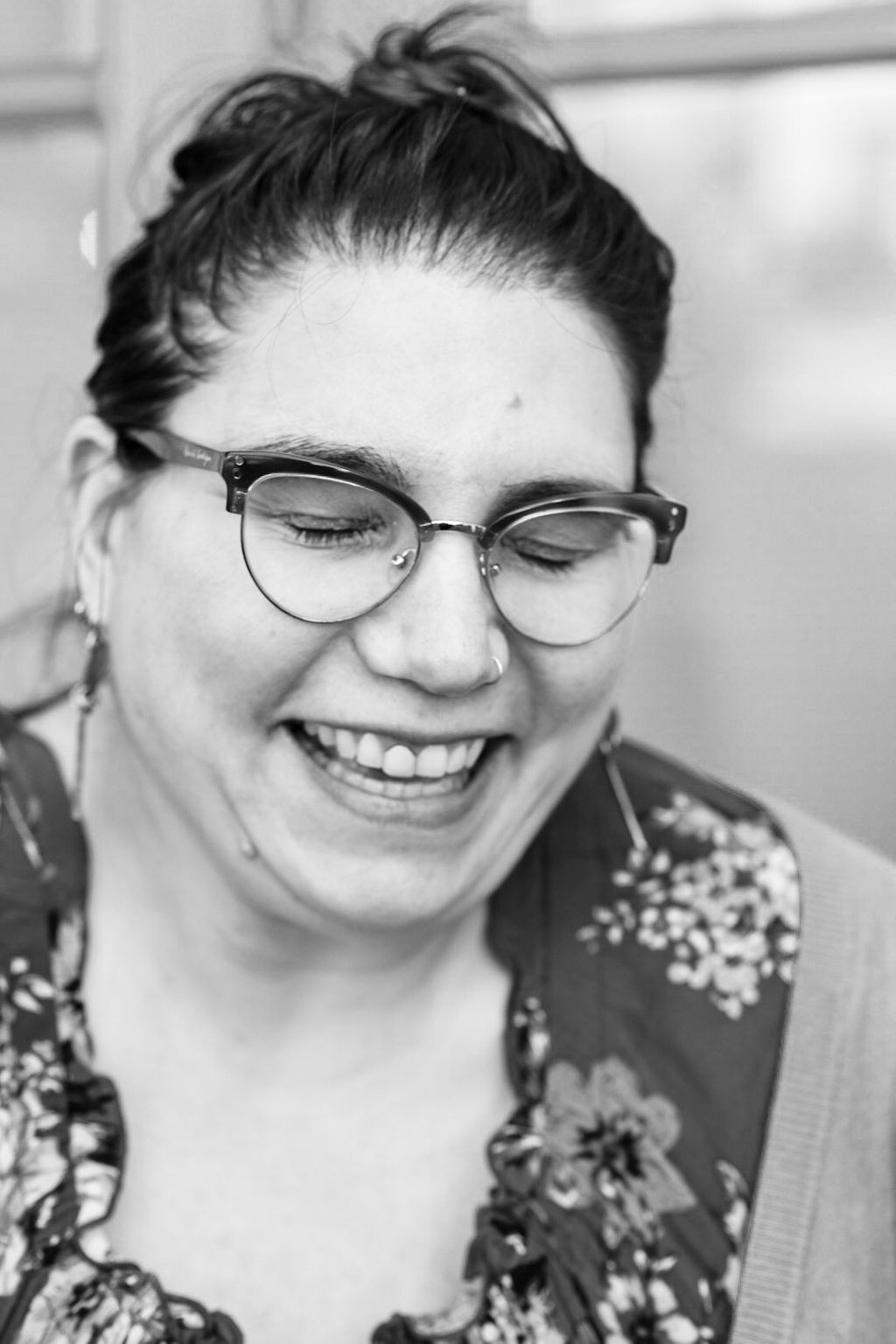
About the Interviewer: Jessi Knippel is an academic, writer, and artist who lives in the Pacific Northwest with her partner and children. She holds a BA in Theatre and Religious Studies, two Master of Arts degrees in the area of Religion and Art, and a Master of Arts in Religion and Gender Studies with a media concentration. Currently, she is researching her PhD dissertation at Claremont Graduate School. The focus of her dissertation is looking at English witch trials and anti-witchcraft codes and their ties to the slave codes and villainization of conjure and hoodoo in South Carolina and Barbados. Some of her other research work includes research on Post/Ex-Evangelicals, Evangelicalism in the US, New Religious Movements, Cults and NRM, syncretism and folk practices in religion, as well as pop culture and religion.
Watch the full conversation with Kimberly B. George on YouTube: https://youtu.be/1atn_jZ__qU