



Diverse spiritualities in defense of collective rights: Quito, Ecuador

By Mónica Maher.
A religious colonial capital of Latin America, San Francisco de Quito is a monolithic Roman Catholic city in the hegemonic imagination. Yet, it is filled with religious diversity which reflects dynamic, socio-cultural processes linked to international movements for justice. The Spiritualities Project of the Foundation Museums of Quito conceptualized by María Fernanda Cartagena and Dayana Rivera, attempts to make visible this diversity, highlighting spiritual expressions which resist the kyriarchal systems of power challenged by critical feminist liberation theologies.
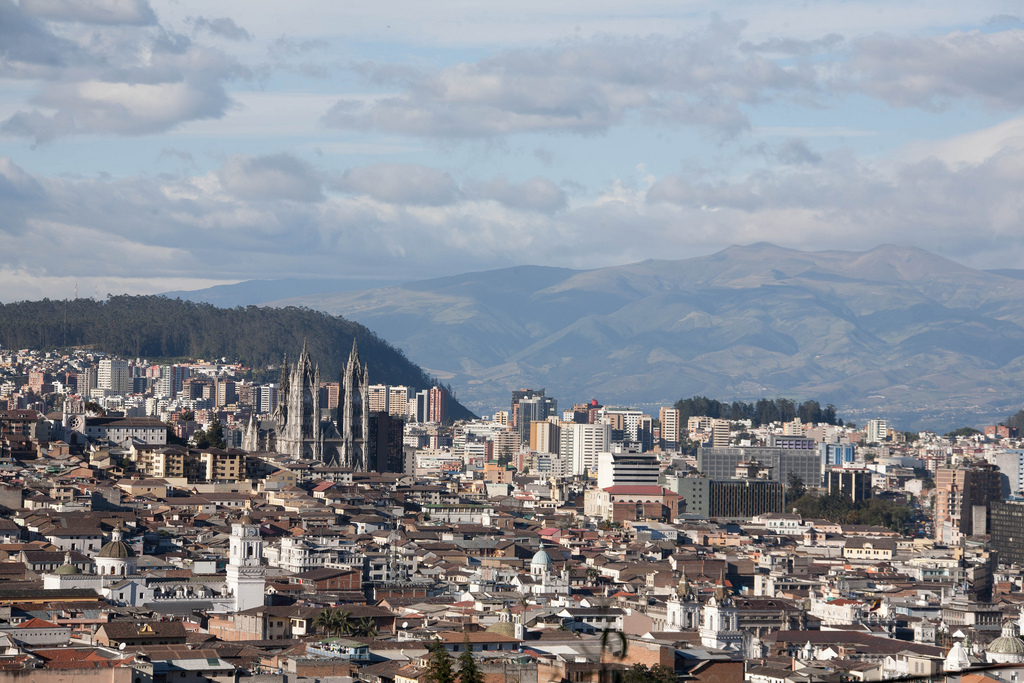
Quito, Ecuador (Creative Commons Image by JPBennett)
Part of a larger process to decolonize the definition of a museum itself—a product of the Spanish conquest, a place to preserve the past, and a means to guard inanimate objects interpreted by outside experts—the Project reframes the museum function as a fluid space of encounter, communal creativity and intercultural dialogue, of collective representation and social questioning, of living subjects in present motion with political agency. Incorporating subaltern wisdom to deconstruct dominant readings of reality, the aim is to promote just peace.
The Project opened late last year in five museums in Quito, including in the Museum of Carmen Alto, also known as the Monastery of Ancient Carmen of San Jose, historic home of the First Ecuadorean saint, Mariana de Jesus, and residence of the cloistered Carmelite nuns since the 17th century. An iconic religious figure of women´s spirituality, Mariana de Jesus died at age 26 after an intense life of self-torture through spiritual mortification. A National Heroine, she is widely revered in Quito, where 7 of 10 women currently report being survivors of gender-based violence. Within this spatial historical context, the challenge is to honor the spiritual aspirations of traditional paths while clarifying the kyriarchal underpinnings of gender-violence that are so often re-inscribed. No doubt a long-term process, this demands ongoing interrogation of deeply embedded concepts such as the sanctity of women´s suffering, the sinfulness of diverse sexualities, and the supremacy of white European culture and Roman Catholicism.
One exhibit of the Project in the Museum of Carmen Alto, entitled Spirituality, Gender and Everyday Life, offers new dimensions of the life of Teresa of Avila, including her challenges to hierarchical ecclesial authority and her powerful written word, helping to deconstruct ahistorical symbols of submissive sainthood and apolitical presentations of ineffable mysticism. A second exhibit on Mysticism and Social Justice offers self-representations of contemporary women´s collectives of Quito.
The Transgender Project: Distinct Bodies, Same Rights founded by Ana Almeida and Elizabeth Vásquez, participates with, Trans Sexual Workers of Quito and the Spirituality of the Street. The installation is at once a celebration of the voices and vitality of trans women and a lament for multiple assassinations of members. In the face of rejection from Catholic clergy, the Transgender Project has developed its own symbols, prayers and sacred oils, responding with spontaneous rituals on the sites where murders have occurred. The exhibit carries these spiritual expressions of resistance from the street inside for the general public to view and re-interpret within an institutional religious space of cloistered Carmelite nuns. This encounter of spiritualities, at once intimate and public, demands recognition of the divinity of distinct bodies and the equality of sexual/gender rights, including the right to life.
The trans women sex workers highlight three aspects of their spirituality: the absence of ethical conflict between their gender identity, their occupation and their religion, which is for the majority Catholicism; closeness to death in the street, and as a result a vision of Quito as an urban cemetery, retraced in a memorial campaign where red hearts and white heels were painted in sites of the assassinations; and finally, collective liturgical creativity and courage to respond to extreme violence and celebrate the sacred, in the face of demonization and exclusion by ecclesial institutions.
Casa Ochún, a multi-generational cultural center led by Afro-Ecuadorean women, represents itself in the Museum with, Ancestral Sounds in the Afro-descendent spiritual practices of Quito. In a context of racial, gender and class discrimination, the founder of Casa Ochún, artistic educator Maestra Rosa Mosquera, received the name, Ochún, in a dream and interpreted it as a call from the ancestors to establish the project. Ochún is the African Goddess of love and sensuality, the Yoruba orisha of sweet water, the muse of poets, patroness of the pregnant, the power of feminine fertility, and the female life force. Mosquera asserts, the ancestors lived through so much…. the music keeps us alive, they can take away everything but they cannot take away our identity and our happiness. Here (in Casa Ochún) there is an overflowing of energy, a hemorrhaging of spirituality.
The installation introduces the public to this vital energy and social force which is Casa Ochún. Music, dance, texts, images, invocation of the power, presence and wisdom of the ancestors. Living souls of survivors of centuries of enslavement. Live drums… channel between earth and sky, past and present, uniting energies, rhythms of nature, of the heart, shared, incarnate, filled with emotion and sensation…the Marimba… fluid and vital as water, purifying, cleaning, opening new roads. Rhythms, words, sounds, historical expressions of strength, hope, creativity, resistance, liberation… rhythms, words, sounds, carrying memories of suffering, survival, strength, celebration, rhythms of beauty of Afro-descendent bodies, spirits, un-relinquished, sources of resilience, currents of energy, courage of a community, Presente.
There has been an outpouring of interest on the part of the collectives involved in the Spiritualities Project, making evident the vibrancy and thirst to share spiritual/social forces in a welcoming space. Solidarity has emerged among the diverse participants through engaged intercultural artistic dialogue. And, initial responses from the public have been very positive.
Many challenges and questions remain. How is it possible to deepen the dialogue between art, spirituality and politics as part of everyday social discourse, opening spaces for the collective expression of creativity and urgent cry for the right to life, life in abundance? What are the ways to strengthen the growing solidarity across diverse social movements in order to expand progressive public discourse in the face of hegemonic morality? The work has just begun.
*This blog is based on a talk given on the panel, Be Creative, Make Change: Feminist Liberation Theologies and the Arts, of the Feminist Liberation Theologians´ Network at the 2015 Annual Meeting of the American Academy of Religion in Atlanta in November.
Rev. Mónica Maher, PhD, is Visiting Professor in the Department of Sociology and Gender Studies at the Latin American Academy of Social Sciences (FLACSO)-Ecuador and Community Minister for Latin America of First Church Cambridge UCC. She served on the Executive Advisory Committee of the Spiritualities Project for the Foundation Museums of the City of Quito, where she lives.